Showing posts with label habitat. Show all posts

Thursday, November 6, 2025

The Arctic Wolf: A Survivor of the Frozen North

The Arctic wolf (Canis lupus arctos) is a remarkable subspecies of the gray wolf, perfectly adapted to one of the most extreme environments on Earth—the High Arctic tundra of North America and Greenland. Often referred to as the “polar wolf” or “white wolf,” this resilient predator thrives where few other large mammals can survive, enduring months of freezing darkness and subzero temperatures.

The scientific name Canis lupus arctos literally means “wolf of the Arctic.” The term Canis is Latin for “dog,” while lupus means “wolf,” and arctos refers to the Arctic region. These wolves inhabit the northernmost reaches of the globe, well beyond the treeline, where snow and ice dominate the landscape for most of the year. Their isolation has shielded them from many of the human threats that plague other wolf populations, such as hunting and habitat loss.

Arctic wolves are instantly recognizable by their thick, white fur, which serves both as camouflage in the snowy tundra and as insulation against the intense cold. Beneath the outer coat lies a dense underlayer that traps body heat. Their bodies are built for survival—shorter muzzles, smaller rounded ears, and compact builds all minimize heat loss. Their large, padded paws act like snowshoes, helping them move across icy terrain with ease.

As carnivorous pack hunters, Arctic wolves primarily feed on large mammals such as muskoxen and caribou. When prey is scarce, they turn to smaller animals including Arctic hares, lemmings, foxes, and even birds or insects. They can survive for weeks without food, relying on fat reserves and teamwork within their packs. Socially, Arctic wolves live in close-knit family groups led by an alpha pair, with all adults contributing to the care and protection of the pups.

Raising young in such an unforgiving landscape poses unique challenges. Because the frozen permafrost makes digging dens nearly impossible, Arctic wolves often use natural shelters like caves or rocky crevices to give birth and protect their pups from the elements.

Although classified as Least Concern by the International Union for Conservation of Nature (IUCN), Arctic wolves face growing threats from climate change and industrial development. Warming temperatures disrupt prey migration and alter their fragile ecosystem. As the Arctic continues to change, the future of these resilient predators will depend on global efforts to protect their environment—a reminder of how deeply all species are connected, even in the planet’s most remote frontiers.
The Arctic Wolf: A Survivor of the Frozen North

Wednesday, February 19, 2025

Elephant Habitats and Conservation: Challenges and Efforts

Elephants, the largest terrestrial animals, inhabit a wide range of natural habitats across Asia and Africa, including savannas, forests, deserts, and marshes. Their ability to thrive in diverse environments demonstrates their remarkable adaptability. However, habitat loss and human activities increasingly threaten their survival.

African Elephant Habitats
African elephants, divided into two subspecies—savanna and forest elephants—occupy distinct ecosystems. The African savanna elephant (Loxodonta africana) roams the vast grasslands of Sub-Saharan Africa, where acacia trees provide shade and food. They rely on seasonal waterholes and rivers, especially during dry months, when competition for water intensifies among wildlife.

In contrast, the African forest elephant (Loxodonta cyclotis) inhabits the dense rainforests of Central and West Africa. These forests provide a constant supply of fruits, leaves, and bark, making them essential for the species' survival. Their smaller size and straighter tusks help them navigate the thick undergrowth. Recent studies highlight their critical role in seed dispersal, promoting forest regeneration.

Asian Elephant Habitats
Asian elephants (Elephas maximus) primarily reside in the tropical and subtropical forests of India, Sri Lanka, Thailand, Myanmar, and other Southeast Asian countries. These regions offer a rich variety of vegetation, including bamboo, grasses, and various fruits. Unlike their African counterparts, Asian elephants have a more fragmented range, often confined to isolated patches of forest due to expanding human settlements.

Seasonal migrations are crucial for Asian elephants, as they follow ancient routes to access food and water. These migratory paths, however, are increasingly disrupted by roads, railways, and agricultural expansion, leading to human-elephant conflicts.

Conservation Challenges and Efforts
Despite their adaptability, elephants face severe threats due to deforestation, agriculture, poaching, and climate change. In Africa, illegal ivory trade remains a pressing concern, while in Asia, habitat fragmentation leads to frequent human-elephant conflicts. Conservation initiatives, such as protected reserves, anti-poaching laws, and wildlife corridors, play a vital role in mitigating these threats.

Technological advancements, such as GPS tracking and AI-driven monitoring, enhance conservation efforts, helping researchers understand elephant movements and improve habitat management. Sustainable land-use policies and global cooperation are essential to securing the future of these majestic creatures.

By safeguarding elephant habitats, we not only protect these intelligent animals but also preserve the ecosystems they support, ensuring biodiversity and ecological balance for future generations.
Elephant Habitats and Conservation: Challenges and Efforts

Thursday, January 30, 2025

Habitat of American Bison

The American bison (Bison bison), commonly referred to as the buffalo, is one of the most iconic species native to North America. Once numbering in the tens of millions, these majestic creatures played a crucial role in shaping the grassland ecosystems of the continent. Historically, bison roamed freely across vast expanses of prairies, grasslands, and plains, spanning from Canada to Mexico. Their primary habitat consisted of open grassy areas with abundant forage, including various species of grasses, sedges, and herbaceous plants. These lands provided the necessary nutrition for large herds that migrated seasonally in search of food and water.

Bison are remarkably well-adapted to diverse environmental conditions, thriving in regions ranging from the Great Plains to river valleys and woodlands. They are highly resilient to both extreme heat and bitter cold, with thick fur and a strong, muscular build that allows them to withstand harsh winters. Access to water sources, such as rivers, streams, and wetlands, is essential for their survival, as bison rely on water for drinking, cooling off, and wallowing—a behavior that helps them deter parasites and regulate body temperature.

The 19th century marked a tragic chapter in the history of the American bison. Widespread overhunting, driven by commercial hide hunters and government policies aimed at subduing Indigenous populations who depended on bison for sustenance, led to a dramatic decline in their numbers. By the late 1800s, the bison population had plummeted from millions to fewer than 500 individuals, pushing the species to the brink of extinction.

Recognizing the urgency of the situation, early conservationists, ranchers, and Native American tribes launched efforts to save the species. The establishment of protected areas, such as Yellowstone National Park, played a crucial role in the survival of bison. Today, thanks to extensive conservation initiatives, the bison population has rebounded to approximately 500,000 individuals. They now inhabit national parks, wildlife refuges, tribal lands, and private reserves, where they contribute to ecosystem restoration and biodiversity conservation.

Despite these successes, challenges remain. Habitat fragmentation, climate change, and the risk of disease transmission from domestic livestock continue to threaten bison populations. Collaborative conservation programs involving government agencies, Indigenous communities, and private landowners are vital in ensuring the long-term survival of these magnificent animals. The American bison, once on the verge of extinction, now stands as a powerful symbol of resilience and conservation success, highlighting the importance of sustained efforts to protect North America’s natural heritage.
Habitat of American Bison

Thursday, June 27, 2024

Golden Eagles: Habitat, Range, and Conservation Challenges

From a distance, the size of golden eagles can lead to confusion with some smaller, medium-sized species of hawks. This majestic bird of prey is widely distributed across the Northern Hemisphere, typically inhabiting open, mountainous regions. The golden eagle’s range covers major wilderness areas in temperate climate zones, stretching north into the steppe and boreal zones and south into the Mediterranean zone.

Occasionally, golden eagles are found in lowland forests and wetlands, but these habitats are usually dominated by the imperial eagle (Aquila heliaca). In North America, golden eagles are prevalent from Alaska to Mexico, predominantly on the western side of the continent, and extending east across Canada, between Hudson Bay and the Great Lakes to Nova Scotia. They prefer open areas with plenty of space for hunting, such as grasslands, shrublands, and deserts.

A similar and closely related species, Verreaux’s eagle (Aquila verreauxii), replaces the golden eagle in southern and eastern Africa. This species is slightly larger and has much darker plumage, earning it the nickname "black eagle." Verreaux’s eagle is primarily found in mountainous and rocky regions, where it preys on hyraxes and other small mammals.
Recent studies have highlighted the importance of conserving these magnificent birds due to habitat loss and human activities. Golden eagles face threats from wind turbines, power lines, and habitat encroachment. Conservation efforts, including tracking programs and habitat protection, are crucial to ensure the survival of these apex predators. As flagship species, golden eagles play a vital role in their ecosystems, and their preservation benefits a wide array of other wildlife. Understanding and mitigating the challenges they face is essential for maintaining the biodiversity of the regions they inhabit.
Golden Eagles: Habitat, Range, and Conservation Challenges

Friday, January 12, 2024

Otters: Family, Habitat, Characteristics

Belonging to the Mustelidae family, otters (Lutrinae) share a close association with martens, polecats, mink, skunks, and badgers. All members of this family exhibit elongated bodies and short legs, serving as predators. Despite their predatory tendencies, these creatures often prefer elusive behavior, favoring serene environments away from urban areas.

The European otter, scientifically labeled as Lutra lutra, derives its name from the Latin term "lutra," signifying otter. Male otters are referred to as dogs, females as butches, and the young ones as cubs.

Specially adapted for an aquatic lifestyle, otters can trace their ancestry back to a common forebear, Mionictis, thriving around 20 million years ago, as revealed by fossil records.

Geographically, otters are widely distributed and can be found on every continent except Antarctica and Australia. They inhabit coastal regions as well as areas alongside rivers, lakes, and marshes.

Within the otter family, the giant otter claims the title of being the largest, measuring approximately 1.8 meters in length. Conversely, the sea otter secures the heavyweight position, weighing around 45 kg.
Otters: Family, Habitat, Characteristics

Monday, August 3, 2020

Tapir (Tapiridae) in general

Tapirs inhabit forests or grassy areas where they can rest and take shelter in vegetation. They prefer areas near water, where they cool off and feed on aquatic plants and fruit from palm trees in gallery forests.

Size varies between types, but most tapirs are about 2 m (7 ft) long, stand about 1 m (3 ft) high at the shoulder, and depending on the species weigh between 150 and 375 kg (330–800 lb) The mountain tapir is the smallest species, and the Asian tapir is the largest. An adult Asian tapir can weigh up to 540 kilograms, but, more often, the weight is in the range of 250–300 kilograms.

Tapirs are mammals. Like all other mammals, tapirs are warm-blooded, they have hair on their body, and females produce milk to feed their young.

Coats are short and range in color from reddish-brown to grey to nearly black, with the notable exceptions of the Asian Tapir, which has a white saddle-shaped marking on its back, and the mountain tapir, which has longer, woolly fur.

Body shape makes tapirs look like large pigs. Their long snout reminds some people of anteaters. Yet neither of these animals is closely related to tapirs. Feet provided the clue for scientists to understand how to classify these animals. Tapirs walk on the end bones of their toes. Toes are protected by a large nail that forms a hoof.

The proboscis of the tapir is highly flexible, and with the ability to move in all directions, it allows the animals to grab foliage that would otherwise be out of reach. Tapirs often exhibit the flehmen response, a behavior in which they raise their snouts and show their teeth in order to detect scents.

The tapir’s trunk has a somewhat similar function as that of an elephant and helps in feeding on branches and leaves. It is very mobile and can be extended or contracted considerably. Apart from the use as a gripping organ it also comes in handy for sniffing and feeling food or other items. Whereas the trunk is quite sensitive, the tapir’s neck is known to be very thick and tough.

Adult tapirs are large enough that they have few natural predators, and the thick skin on the backs of their necks helps to protect them from threats such as jaguars, crocodiles, anacondas, and tigers. They are also able to run fairly quickly considering their size and cumbersome appearance.

There are four species of tapirs:
Baird’s tapir
Lowland tapir
Mountain tapir
Malayan tapir
Tapir (Tapiridae) in general

Thursday, November 14, 2019

Habitat of Wild cat

The wildcat is a medium-sized carnivore with wide geographical distribution, present in three continents (Europe, Africa and Asia) which are inhabited by different subspecies.

The European wildcat distributions show a fragmented pattern, with populations across the entire Iberian Peninsula, northeastern France bordering Belgium, Germany, Scotland, Italy, Greece, Eastern Europe, Turkey, and the Caucasus.

The species behaves as a facultative specialist predator, capable of surviving on a wide variety of prey (from insects to hares), but facultatively specializing on wild rabbit (Orcytolagus cuniculusL.) or rodents depending upon their availability.

Wildcats live in habitats that satisfy two main requirements: shelter and food. Woodlands and areas of dense gorse or juniper thickets provide shelter and resting places.

Wildcats require open patches of habitat, such as pastures or riparian areas, for hunting. However, when moving around their territories, they prefer to avoid open areas, using woodland or scrub and stream edges for cover. The Spanish Red Data List for Mammals stated that wildcats are mainly forest inhabitants. In Spain there are various types of open habitat which might be suitable for wildcats, such as semi–arid environments, or agricultural steppes where the landscape is dominated by crops

Young forestry plantations in particular are also an important habitat for wildcats because they are protected from grazing and support a high density of small mammal prey. Rocky areas also provide den shelters for female wildcats during the breeding season.
Habitat of Wild cat

Saturday, May 13, 2017

Habitat of otters

Otters are particularly fastidious animals and are highly selective in their choice of habitat. On land, otters need safe refuges in which to sleep and breed.

Some, like the smooth otter, may excavate their own den, but most make use of ready existing facilities such as a hole in the river bank cavities amongst tree roots, in waterside scrub, reed beds or marshes.
The vast geographic range in which the river otter is found, from marine environment to high mountain lakes to desert canyons, is testament to their ability to adapt to a variety of aquatic habitats.

Otters are generally most abundant along food-rich coastal areas estuaries, the lower portions of streams, and coastal marshes, in locations with the least amount of human disturbance. In Canada they occur north beyond the tree line in tundra lakes and streams.

In west-central Idaho, prey availability had the greatest influence on habitat use by river otter but adequate shelter was necessary for extensive habitat use.
Habitat of otters

Tuesday, April 18, 2017

Badger

Badgers are carnivores of the family Mustelidae, which also includes weasels, ermines, minks, ferrets, skinks, otter, and wolverines.

They are large, powerful, mainly nocturnal animal, which has no natural predators. Badgers have a natural life span of around 10-15 years.

Badgers live in many habitats including grasslands and forests. The American badger lives in the western part of North America. The Eurasian badger can be found in Europe and Asia. The other types live in Southeast Asia.
Badgers have short legs that are good for scurrying down tunnels. Their burrows, know as setts, are passed down through generations of badgers. They tend to hunt at night.

Most badgers have gray or brown fur. Many types have black-and-white marks on the face and back.

In the West the animal’s character is generally seen as negative, sly, solitary, clumsy and secretive. Studies in England showed that badgers organized in clans of a dozen individuals live in extensive and complex burrows that may used for decades or even centuries.
Badger

Monday, July 18, 2016

Rocky Mountain goat (Oreamnos americanus)

Rocky Mountain goat or mountain goats are native to the Cascade Mountains in central Washington, as well as other area of western Canada and the United States. It was introduce to the Southern Rocky Mountains by the Colorado Division of Wildlife beginning in 1949.

The Rocky Mountain goat is not a true goat but one of the so-called goat-antelopes closely related to the chamois, Rupicapra rupicapra of Eurasia. With its short neck, large head and pure white coat, it looks more like a domestic animal than a wild species.

Rocky Mountain goats prefer steep rocky slopes above 6000 feet in elevation, although they use lower elevation areas periodically during winter.

The subfamily Caprinae include all true mountain-dwelling ungulates, characterized by high developed climbing skills, reliance on cliffs or steep terrain to escape predation, presence of horns in both sexes and for most species a complex seasonal pattern of home range use.
Rocky Mountain goat (Oreamnos americanus)

Wednesday, June 8, 2016

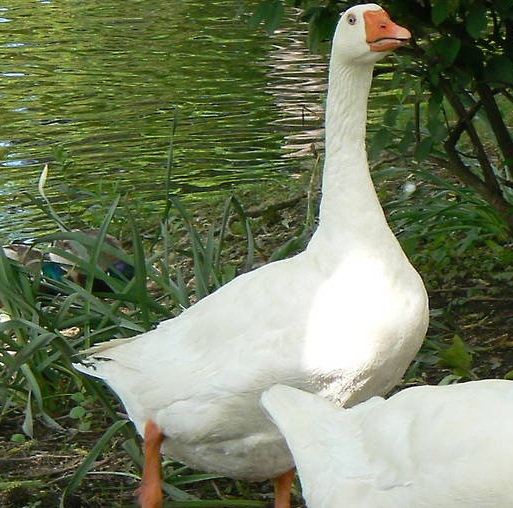
Goose

Geese are large birds with loud honking calls. Along with dicks and swans they belong to a group of birds called waterfowl in North America and wildfowl in Europe.

Geese have heavier bodies and longer necks than ducks but are smaller than swans.

These birds are equally at home on the water on the land or in the air. Common species or types of goose include the Canada goose the graylag, the barnacle goose, and the snow goose.

By 3000 BC geese were common in China and the Middle East. They were raised in ancient Egypt and have been part of everyday life in Western Europe since prehistoric times.

Geese usually feed on slugs, snails, worms, mice, hamsters, wheat, barley and froglets. They always fly in the shape of a ‘V’, as it allows at least 71% greater flying range. When goose in the lead gets tired, another goose takes over the position.
Goose

Monday, July 6, 2015

The wombats

Wombats are ancient animals. Marsupials – the pouched mammals, of which the wombat is one – evolved about 100 million years ago, but the Australian fossil record is woefully sparse.

Wombats are grazing animals and are among the world’s largest burrowers. All wombats live in burrows underground. They use their strong limbs to dig into and sweep away soil. To enlarge a tunnel, a wombat rolls onto its back and scratches at the walls.

The wombat has a chunky physique, short legs and a generally uncouth and frowsy look. They have large flat heads with small eyes.
Southern hairy-nosed wombat 
The average wombat is about a yard long from the tip of his nose to his vestigial tail.

The average weight of mainland wombats is about 26 kilograms, but weights of 35 kilograms are not uncommon.

Tasmanian wombats are slightly smaller. Tasmanian wombats have tough hides and thick, coarse hair. They lead extremely boresome lives.

Three wombat species belong to the family Vombatidae:
*The southern hairy-nosed wombats
*The northern hairy-nosed wombats
*The common wombats
The wombats

Friday, June 12, 2015

Wild mongooses

Mongooses are small mammals. They are fearless predators, have long bodies and short legs. Mongooses are essentially terrestrial. Nearly all species are very poor tree-climbers and are rarely seen on anything but the lowest branches.

However, Herpestes sanguineus is exceptional and its climbing ability is said to resemble that of a squirrel.

They live in forests, savannahs and dry grasslands.  Many more mongoose species live in grassland habitats. These habitats have two distinct seasons and constantly high temperatures.

All species swim well when force to do so and a few species are semi-aquatic or aquatic such as Atilax in Africa, Herpetes urva and H. vitticollis in India and H. brachyurus in the East Indies.

Members of the mongoose family are other social or solitary mammals. Many of the mongoose species that live outside Africa are solitary animals.
Wild mongooses

Wednesday, May 13, 2015

Genet (Viverra genetta)

The common Genet, G. vulgaris – Viverra genetta of Linnaeus is a beautiful reddish gray spotted with small black or brown patches, which are sometimes round and sometimes oblong.

The tail which is as long as the body is ringed with black and white, the black rings being to the number or nine or eleven.

They are attractive, cat-like animals with long and slender bodies, about 20 inches  in length, and weigh about 6 pounds. Genets are agile climbers, using their short, curved, retractile claws to traverse branches upside down and descend trees headfirst.

This animal also purrs, hisses and arches it back like a cat.  Genets jump well, have a slinking walk, trot and run in a diagonal stride and jump-run with body alternately flexing and extending.

This animal is found both in a wild and domestic state in the south of Europe and thence southward through Africa to the Cape of Good Hope.

The large spotted genet lives in sub-Saharan Africa, excluding the arid south western zone.
Genet (Viverra genetta)

Saturday, March 28, 2015

Porcupine family

Porcupines rank among the world’s most widely recognized animals. The word porcupine comes from two latin words, porcus, ‘swine’ and spina, ‘thorn’.

Porcupines belong to two separate families of the Hystricomorph suborder of rodents. One family, the Erethizontidae, lives in the New World (North and South America).

The other family, the Hystricidae, lives in the Old World (Eurasia and Africa). Porcupines are found on every continent except Australia and Antarctica. Adults are around 30 inches long, including a 6 to 10 inch tail.

The porcupine characterizes North America as strongly as do the bison and the wild turkey. When hunched up in the tree, the animal may look like a dark knot on a branch.

When threatened, it presents a bristling back of white quill bases. The porcupine is the only North America mammal with body hairs modified as quills. Adult quills typically range between 2 and 10 cm in length.

Porcupines vary in color from brownish black to pure black, sprinkles on the sides and belly with yellow or white-tipped hairs.

Healthy porcupine cm live for 10 years or more, subsisting primarily on the bark, leaves, and new buds of sugar maples, beeches, cedars, aspens and birches.

From the late summer through fall, it forages for apples, acorns, alfalfa, dandelions and seeds.
Porcupine family

Tuesday, January 27, 2015

Moose (Eurasian elk)

Moose are the largest members of the deer family, a group that also includes caribou, elk and white tailed deer.  But unlike the other deer species, moose are usually solitary animals, preferring to live alone. They are also one of the largest land mammals in North America.

Moose love in the United States and Canada. They also live in parts of northern Europe and Asia, where they are called elk.

A moose makes its ho0me in and near the forests, swamps and bodies of water found in these regions. Moose habitat has to heave leafy trees and freshwater. It also has to have cold weather.

Moose have large bodies and heads. They are more than 6 feet tall. They have lumps on their shoulders. Their legs are long and thin. Moose’s front legs are longer than their back legs. In winter, a moose’s long legs help it move though deep snow. Moose can even run in deep snow.

A moose can weigh from 600 to 1800 pounds. Just one moose could weigh more than 20 children. Despite its huge size and weight, the moose is very agile.
Moose (Eurasian elk)

Popular Posts