The ocelot (Leopardus pardalis) is a medium-sized Neotropical spotted cat is a wild cat distributed over South and Central America and Mexico. Ocelots can be found from Arizona and southwestern Texas to every country south except Chile. The ocelot seems to prefer dense cover but can use a variety of habitats, hunting in the brushy forests and semi-arid deserts in the northern part of its range as well as the tropical forests, mountain slopes, and pampas located throughout its southern range.
It is up to 100 cm (3'2") in length, plus 45 cm (1'6") tail length, and weighs 10-15 kg (about 20-33 pounds). The ocelot, a larger member of the small cat group, is a beautiful spotted cat with short hair. Its body coloration ranges from tawny to reddish-brown. They have black markings – spots, stripes along their sides and faces, and rosettes on their back. A key feature is the parallel stripes running down the nape of the neck.
While similar in appearance to the oncilla and the margay, who inhabit the same region, the ocelot is larger.
The ocelot is mostly nocturnal and very territorial. They will fight fiercely, sometimes to the death, in territorial disputes. Ocelots sleep during daylight hours, either draped along a high tree limb or in a sheltered den, which may be a hollow tree, small cave, or a shallow depression under vegetation. The ocelot climbs, jumps, and swims well.
Wild cat of ocelots
Showing posts with label cat. Show all posts
Tuesday, November 6, 2018
Friday, August 10, 2018
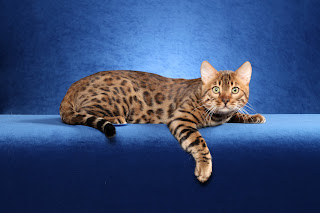
Bengal cat
The Bengal Cat is a relatively new cat breed. They are a hybrid between the Asian Leopard Cat (which is required to have a licence under the legislation) and the domestic cat.
The name “Bengal cat" was derived from the taxonomic name of the Asian leopard cat (Prionailurus bengalensis bengalensis), and not from the more distantly related Bengal tiger.
They have a "wild" appearance with large spots, rosettes, and alight/white belly, and a body structure reminiscent of the Asian Leopard Cat, but once separated by at least four generations from the original crossing possess a gentle domestic cat temperament.
They are generally kept as domestic cats in people’s homes. Bengal cats have "wild-looking" markings, such as large spots, rosettes, and a light/white belly, and a body structure reminiscent of the leopard cat. A Bengal's rosette spots occur only on the back and sides, with stripes elsewhere.
Most, but not all, worldwide cat associations recognise Bengals, and some registries recognize the Savannah and Chausie hybrid breeds.
Bengal cat
The name “Bengal cat" was derived from the taxonomic name of the Asian leopard cat (Prionailurus bengalensis bengalensis), and not from the more distantly related Bengal tiger.
They have a "wild" appearance with large spots, rosettes, and alight/white belly, and a body structure reminiscent of the Asian Leopard Cat, but once separated by at least four generations from the original crossing possess a gentle domestic cat temperament.
They are generally kept as domestic cats in people’s homes. Bengal cats have "wild-looking" markings, such as large spots, rosettes, and a light/white belly, and a body structure reminiscent of the leopard cat. A Bengal's rosette spots occur only on the back and sides, with stripes elsewhere.
Most, but not all, worldwide cat associations recognise Bengals, and some registries recognize the Savannah and Chausie hybrid breeds.
Bengal cat
Thursday, December 14, 2017
Mountain lion of cougar
Cougar has been known by many names: puma, mountain lion, cougar, catamount, mountain screamer, sneak cat, panther and more.
The name cougar is a combination of the two Brazilian words for the jaguar (Pantera onca); cuacuara and quacuara. The name puma, adopted in the late 1700s by the Spanish conquistadores, comes from the Peruvian Quechua Indians.
The cougar was originally described as Felis concolor by Linnaeus in 1758 and later recognized as Felis (Puma) concolor by Jardine in 1834, with puma recognized as a subgenus of Felis. In 1973 taxonomists reclassified Puma as a separate genus.
Molecular evidence indicates that the cougar is a member of the puma lineage, which includes cheetah and jaguarandi and not allied with the small cat genus Felis.
Cougar is its South American name and name comes from the Quechua language spoken by the Incas.
The cougar is the second-largest cat in the western hemisphere. It is also one of the fastest and most powerful of animals. But it tires quickly. It is powerful enough to kill with its bite or its claws.
Cougars have an amazing ability to adapt to almost any type of habitat. They can swim, climb trees, and jump up to 15 feet high.
All the skills, along with their sharp eyesight and keen hearing, make them excellent hunters that can adapt to life in mountains, forest, desert, plains and wetlands.
The cougar generally subsists on birds and small quadruples, such as young deer, raccoons, skunks and the like: in South America the monkeys and peccaries frequently become its prey.
Mountain lion of Cougar
The name cougar is a combination of the two Brazilian words for the jaguar (Pantera onca); cuacuara and quacuara. The name puma, adopted in the late 1700s by the Spanish conquistadores, comes from the Peruvian Quechua Indians.
The cougar was originally described as Felis concolor by Linnaeus in 1758 and later recognized as Felis (Puma) concolor by Jardine in 1834, with puma recognized as a subgenus of Felis. In 1973 taxonomists reclassified Puma as a separate genus.
Molecular evidence indicates that the cougar is a member of the puma lineage, which includes cheetah and jaguarandi and not allied with the small cat genus Felis.
Cougar is its South American name and name comes from the Quechua language spoken by the Incas.
The cougar is the second-largest cat in the western hemisphere. It is also one of the fastest and most powerful of animals. But it tires quickly. It is powerful enough to kill with its bite or its claws.
Cougars have an amazing ability to adapt to almost any type of habitat. They can swim, climb trees, and jump up to 15 feet high.
All the skills, along with their sharp eyesight and keen hearing, make them excellent hunters that can adapt to life in mountains, forest, desert, plains and wetlands.
The cougar generally subsists on birds and small quadruples, such as young deer, raccoons, skunks and the like: in South America the monkeys and peccaries frequently become its prey.
Mountain lion of Cougar
Monday, December 14, 2015
European wildcat
European wildcat (Felis silvestris silvestris) looks like a large domestic tabby cat, but with a broader head and darker fur. A long, thick coat, broad head and comparatively flat face give it the appearance of a large, powerful cat, much more robust than the domestic cat or the African wildcat.
Looks are deceiving, however, as European wildcats typically weigh 3 to 6 kilograms, about the same as African wildcats. The European wildcat is a compact animal with comparatively short legs and tail that usually exceeds half of its head and body length.
The African wildcat, formerly known as Felis libyca, would be the ancestor and it is now considered to belong to the same widely distributed species as the European wildcat (F. silvestris) and its Asian relatives (formerly F. ocreata).
The European wildcat is found in the north and east of Europe, also in the Scottish Highlands. It is a forest dweller and has a yellowish-grey fur with black markings.
Though European wildcats eat a variety of small prey, there are numerous reports indicating that these cats are primarily rodent catchers. They do, however, also feed on larger animals, such as hares, rabbits and young deer.
European wildcat
Looks are deceiving, however, as European wildcats typically weigh 3 to 6 kilograms, about the same as African wildcats. The European wildcat is a compact animal with comparatively short legs and tail that usually exceeds half of its head and body length.
The African wildcat, formerly known as Felis libyca, would be the ancestor and it is now considered to belong to the same widely distributed species as the European wildcat (F. silvestris) and its Asian relatives (formerly F. ocreata).
The European wildcat is found in the north and east of Europe, also in the Scottish Highlands. It is a forest dweller and has a yellowish-grey fur with black markings.
Though European wildcats eat a variety of small prey, there are numerous reports indicating that these cats are primarily rodent catchers. They do, however, also feed on larger animals, such as hares, rabbits and young deer.
European wildcat
Wednesday, May 13, 2015
Genet (Viverra genetta)
The common Genet, G. vulgaris – Viverra genetta of Linnaeus is a beautiful reddish gray spotted with small black or brown patches, which are sometimes round and sometimes oblong.
The tail which is as long as the body is ringed with black and white, the black rings being to the number or nine or eleven.
They are attractive, cat-like animals with long and slender bodies, about 20 inches in length, and weigh about 6 pounds. Genets are agile climbers, using their short, curved, retractile claws to traverse branches upside down and descend trees headfirst.
This animal also purrs, hisses and arches it back like a cat. Genets jump well, have a slinking walk, trot and run in a diagonal stride and jump-run with body alternately flexing and extending.
This animal is found both in a wild and domestic state in the south of Europe and thence southward through Africa to the Cape of Good Hope.
The large spotted genet lives in sub-Saharan Africa, excluding the arid south western zone.
Genet (Viverra genetta)
The tail which is as long as the body is ringed with black and white, the black rings being to the number or nine or eleven.
They are attractive, cat-like animals with long and slender bodies, about 20 inches in length, and weigh about 6 pounds. Genets are agile climbers, using their short, curved, retractile claws to traverse branches upside down and descend trees headfirst.
This animal also purrs, hisses and arches it back like a cat. Genets jump well, have a slinking walk, trot and run in a diagonal stride and jump-run with body alternately flexing and extending.
This animal is found both in a wild and domestic state in the south of Europe and thence southward through Africa to the Cape of Good Hope.
The large spotted genet lives in sub-Saharan Africa, excluding the arid south western zone.
Genet (Viverra genetta)
Thursday, April 16, 2015
Civet
Civets, also known as civet cats, are not related to cats and have shorter legs and longer muzzles than do cats.
There are 17 species of civets although ‘civet’ is a generic name not related to a scientific classification and the grouping of these species varies according to which authority is followed. Civet cats are native to Africa, the animals are also found in India, Malaysia, Indochina and Indonesia.
Originally derived from an Arabic term the word civet was at first used to denote a scent obtained from the African civet.
This animal is remarkable for the production of the drug called civet, sometimes erroneously confounded with musk. This is a substance which is fund in a large double glandular receptacle situated at a little distance beneath the tail,
The diet of civets is typically varied. It may include insects, crabs and other invertebrates, as well as frogs, lizards, snakes, fish, birds and mammals.
The civet is nearly two feet and a half in length; the tail is more than one foot, and the mean height of the animal is about one foot three inches.
Civet
There are 17 species of civets although ‘civet’ is a generic name not related to a scientific classification and the grouping of these species varies according to which authority is followed. Civet cats are native to Africa, the animals are also found in India, Malaysia, Indochina and Indonesia.
Originally derived from an Arabic term the word civet was at first used to denote a scent obtained from the African civet.
This animal is remarkable for the production of the drug called civet, sometimes erroneously confounded with musk. This is a substance which is fund in a large double glandular receptacle situated at a little distance beneath the tail,
The diet of civets is typically varied. It may include insects, crabs and other invertebrates, as well as frogs, lizards, snakes, fish, birds and mammals.
The civet is nearly two feet and a half in length; the tail is more than one foot, and the mean height of the animal is about one foot three inches.
Civet
Monday, March 19, 2012
The domestic cat
The cat is a much loved and well-known animal. In farms its value as a rodent catcher has been appreciated for centuries. Loved and familiar though it is, the cat remains an enigma.
The earliest known companion cat dates to about 4500 years ago, when a cat was buried with its master in an Egyptian tomb. Cats in Egypt were often mummified and placed in tombs as members of the family.
Cats are intelligent, highly specialized mammals that evolved a range of morphological adaptations and sensory abilities to suit their exclusively carnivorous lifestyle.
Hunting by sight at night mean they see in lower light intensities then the people can and are particularly sensitive to rapid movement.
Cats living together in feral groups do interact affectionately. Similar, in multi-cat households, adult cats may greet each other with head rubbing, and they may lie together and groom each other, although such interludes are often tempered with an occasional spat.
The relationship between cats and people has shown considerable evolution and change over the centuries. The main ancestor of the domestic cat, the African wildcat of North America Felis silvestris lybica, overlapped the March cat Felis chaus in its range in Egypt along the Nile.
Today, there are more than fifty five million cat owners in the United States, making cats the number one household.
The earliest known companion cat dates to about 4500 years ago, when a cat was buried with its master in an Egyptian tomb. Cats in Egypt were often mummified and placed in tombs as members of the family.
Cats are intelligent, highly specialized mammals that evolved a range of morphological adaptations and sensory abilities to suit their exclusively carnivorous lifestyle.
Hunting by sight at night mean they see in lower light intensities then the people can and are particularly sensitive to rapid movement.
Cats living together in feral groups do interact affectionately. Similar, in multi-cat households, adult cats may greet each other with head rubbing, and they may lie together and groom each other, although such interludes are often tempered with an occasional spat.
The relationship between cats and people has shown considerable evolution and change over the centuries. The main ancestor of the domestic cat, the African wildcat of North America Felis silvestris lybica, overlapped the March cat Felis chaus in its range in Egypt along the Nile.
Today, there are more than fifty five million cat owners in the United States, making cats the number one household.
The domestic cat
Subscribe to:
Posts (Atom)
Popular Posts
-
The Grey-cheeked Thrush ( Catharus minimus ), affectionately nicknamed the "Grey-cheese bird" due to a playful mispronunciation, i...
-
The red-headed woodpecker ( Melanerpes erythrocephalus) stands out among North American birds with its vivid crimson head, jet-black back, ...
-
Hedgehogs are small, spiny mammals belonging to the subfamily Erinaceinae within the family Erinaceidae. There are seventeen species of hedg...
-
The Psittrichas fulgidus , commonly known as the Dracula parrot, is a striking and unique bird native to the rainforests of New Guinea. This...
-
The American bison, often called the buffalo, stands as an iconic symbol of the Great Plains, embodying the resilience of North America'...