The Anseriformes are divided into two families distinguished by the absence or presence of horny lamellae in the beak: (1) screamers (Anhimidae), and (2) ducks and geese (Anatidae).
Anhimidae today only occur in South America and include three species that are distinguished from other anseriform birds in numerous features, including an unspecialized and rather galliform-like beak, the absence of webbed feet, and a highly pneumatized skeleton.
Screamers are a small group of peculiar aquatic birds found only in South America.. They are almost goose-size birds of fowl-like appearance, with fairly thick, long legs and feet without webs. The weight is 2-3 kilograms.
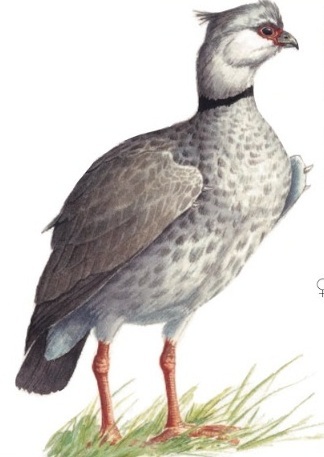
Heavy bodied and superficially gooselike, they have many unusual anatomical features that suggest an ancient lineage. Among other things, they lack feather tracts; the feathers on the head and neck are very short, soft, and downy; and the skin is thick and spongelike.
Screamers take their name from their loud, far-carrying calls. Two sharp, bony spurs project from the bend of each wing. The spurs are used in fighting, either between rival screamers or to drive off enemies, including hunting dogs and other predators.
Screamers of Anhimidae
Showing posts with label South America. Show all posts
Friday, March 23, 2018
Thursday, September 18, 2014
Jaguarundi (Herpailurus yaguarondi)
One of the most unusual and poorly known wild cats is the Jaguarundi. Jaguarundis are small animals, only about 21 to 30 inches (53 ton76 cm) long, not including their tails. They weigh between 7 to 15 pounds (3 and 7 kg).
This cat is characterized by a slender, elongated body and a small, slim head; small, and round ears.
Jaguarundi has a long, thick tail, which it uses to steady itself when it is running or jumping to catch prey.
The jaguarundi differs from all other types of cat due to the form of some of its chromosomes and by the number of chromosomes – there are 36 instead of the 38 found in other cats.
There is a suggestion that jaguarundi is more closely related to the cheetah and puma than to the other South American cats. German scientists gave the jaguarundi its name in 1803. Jaguarundi means ‘weasel cat’ in German.
The jaguarundi’s range extends from southern Texas through the coastal lowlands of Mexico, southward throughout Central; America and into South America east of the Andes to northern Argentina.
The habitat requirements of the jaguarundi are not well known, but it normally thought to be a lowland species.
It appears to inhabit areas of thick undergrowth, preferably near water and is reputedly a good swimmer.
Extremely agile and an excellent hunter, the jaguarundi hunts primarily on the ground. It eats quail, wood quail, tinamous, small rodents, armadillos, lizards, and insects.
Jaguarundi (Herpailurus yaguarondi)
This cat is characterized by a slender, elongated body and a small, slim head; small, and round ears.
Jaguarundi has a long, thick tail, which it uses to steady itself when it is running or jumping to catch prey.
The jaguarundi differs from all other types of cat due to the form of some of its chromosomes and by the number of chromosomes – there are 36 instead of the 38 found in other cats.
There is a suggestion that jaguarundi is more closely related to the cheetah and puma than to the other South American cats. German scientists gave the jaguarundi its name in 1803. Jaguarundi means ‘weasel cat’ in German.
The jaguarundi’s range extends from southern Texas through the coastal lowlands of Mexico, southward throughout Central; America and into South America east of the Andes to northern Argentina.
The habitat requirements of the jaguarundi are not well known, but it normally thought to be a lowland species.
It appears to inhabit areas of thick undergrowth, preferably near water and is reputedly a good swimmer.
Extremely agile and an excellent hunter, the jaguarundi hunts primarily on the ground. It eats quail, wood quail, tinamous, small rodents, armadillos, lizards, and insects.
Jaguarundi (Herpailurus yaguarondi)
Monday, August 25, 2014
Blastocerus dichotomus or Marsh deer
The South American marsh deer, like the Asiatic swamp deer, is large and has specialized legs. Marsh deer prefer to be in or near standing water not more than 60 cm deep, with low cover such as reeds or bunch-grasses nearby. They avoid dense forest.
It is the largest native deer of South America (male 110 kg, female 70 kg), with males reaching a height of up to 115 cm.
Marsh deer occupies floodplains with tall grass, bushes and clumps of forest along the Rio Parana and in Paraguay. It is listed as an endangered species but it occurs at high populations densities in the Pantanal.
Numbers and distribution have declined substantially through loss of habitat to agriculture, marsh drainage, controlled hunting and transmission of disease from domestic livestock.
During the rainy season, when the grassland are flooded the deer are forced onto a limited amount of high patches of ground from where cattle are likely to displace them and will outcompete them for limited forage, causing mortality if the floods are usually prolonged or the islands too small.
It lives alone in small groups, reproduces year-round, is dusk and dawn active, hides in dense vegetation, has an explosive getaway, and runs with its tail raised, similar to white tailed deer.
Blastocerus dichotomus or Marsh deer
It is the largest native deer of South America (male 110 kg, female 70 kg), with males reaching a height of up to 115 cm.
Marsh deer occupies floodplains with tall grass, bushes and clumps of forest along the Rio Parana and in Paraguay. It is listed as an endangered species but it occurs at high populations densities in the Pantanal.
Numbers and distribution have declined substantially through loss of habitat to agriculture, marsh drainage, controlled hunting and transmission of disease from domestic livestock.
During the rainy season, when the grassland are flooded the deer are forced onto a limited amount of high patches of ground from where cattle are likely to displace them and will outcompete them for limited forage, causing mortality if the floods are usually prolonged or the islands too small.
It lives alone in small groups, reproduces year-round, is dusk and dawn active, hides in dense vegetation, has an explosive getaway, and runs with its tail raised, similar to white tailed deer.
Blastocerus dichotomus or Marsh deer
Saturday, March 29, 2014
Vicuñas: South American camelids
There are two wild South American camelids, the vicuñas (Vicugna vicugna) and the guanaco (Lama guanicoe).
The vicuñas is the smallest of the extant camelids, weighing 45 to 55 kg and standing only 86 to 96 at the shoulder.
Unlike guanacos, vicuñas are specialist grazers of low growing forbs and perennial grass on the high puna, where their very fine wool insulates against severe cold.
Vicuñas live in family groups of between five and ten individuals, led by a dominant male. At adulthood, males leave the family to form bachelor groups of their own.
Each family group usually has two territories. The larger feeding territory may cover as much as 18.2 hectares. A smaller, more isolated territory is reserved for sleeping.
There are two recognized varieties of vicunas, the northern or Peruvian vicuna with its characteristics chest markings is found in Peru, Bolivia, and northern Chile.
The larger southern variety commonly described as the ‘Argentine’ vicuna, lacks the lighter colored chest markings and is found in Argentina and central Chile.
Vicuña lives at altitudes higher than 3,658 meters and is specially adapted to the rigors of the Andes. The vicuña fur is considered the finest in the world and it works to trap air and keep the animals warm in frigid temperatures.
Vicuñas: South American camelids
The vicuñas is the smallest of the extant camelids, weighing 45 to 55 kg and standing only 86 to 96 at the shoulder.
Unlike guanacos, vicuñas are specialist grazers of low growing forbs and perennial grass on the high puna, where their very fine wool insulates against severe cold.
Vicuñas live in family groups of between five and ten individuals, led by a dominant male. At adulthood, males leave the family to form bachelor groups of their own.
Each family group usually has two territories. The larger feeding territory may cover as much as 18.2 hectares. A smaller, more isolated territory is reserved for sleeping.
There are two recognized varieties of vicunas, the northern or Peruvian vicuna with its characteristics chest markings is found in Peru, Bolivia, and northern Chile.
The larger southern variety commonly described as the ‘Argentine’ vicuna, lacks the lighter colored chest markings and is found in Argentina and central Chile.
Vicuña lives at altitudes higher than 3,658 meters and is specially adapted to the rigors of the Andes. The vicuña fur is considered the finest in the world and it works to trap air and keep the animals warm in frigid temperatures.
Vicuñas: South American camelids
Monday, February 3, 2014
Wild Guanacos of South America
Today, this species found in southern Peru along the Andean zone of Chile and Argentina and thence to Tierra de Fuego and Navarino Island.
This species inhabits arid, semi-arid, hilly, mountain, steppe and temperate forest environments.
It is the largest of the wild South American camelids, weighing 100 to 130 kg and standing to 100 to 120 cm at the shoulder.
As generalized browsers and grazers, guanacos can be either sedentary or migratory depending upon local conditions and the seasonal need to relocate for forage. They are by nature the most adaptable, and thrive in a broad range of ecosystems.
Cold or temperate open areas such as shrub-steppe and semi-arid brushlands are preferred, but the habitat may range from desserts of the western Andean slopes to the wet coastal rainforest of Tierra del Fuego.
The guanaco exist only in the wild and has a shaggy coat dark chestnut brown and looks somewhat like Llama.
Wild Guanacos of South America
This species inhabits arid, semi-arid, hilly, mountain, steppe and temperate forest environments.
It is the largest of the wild South American camelids, weighing 100 to 130 kg and standing to 100 to 120 cm at the shoulder.
As generalized browsers and grazers, guanacos can be either sedentary or migratory depending upon local conditions and the seasonal need to relocate for forage. They are by nature the most adaptable, and thrive in a broad range of ecosystems.
Cold or temperate open areas such as shrub-steppe and semi-arid brushlands are preferred, but the habitat may range from desserts of the western Andean slopes to the wet coastal rainforest of Tierra del Fuego.
The guanaco exist only in the wild and has a shaggy coat dark chestnut brown and looks somewhat like Llama.
Wild Guanacos of South America
Wednesday, October 2, 2013
Alpacas of Andes Mountains
Alpacas are members of the camelid family. The camelid family includes camels from Africa and Llamas, alpacas, guanacos and vicunas from South America.
In South America, alpacas live in the cold, windy Andes Mountains. The alpaca is farmed mainly for fibre. Alpacas are also used to guard other stock. Males over two years of age are particularly useful to chase fixes or dogs, protecting other livestock such as sheep.
South American camelids were a vital part of life in the Andes in the days of the Incas before the arrival of the Spanish Conquistadors. During that time, the wearing of robes of alpaca was reserved for the nobility and royalty.
Alpacas are slender-bodied animals with a long neck and legs, a short tail, a small head and large pointed ears. They are about one-half the size of a llama, Alpacas weigh between 100-200 pounds and are about 36 tall at the withers.
Alpacas can come in a very wide variety of colors. The main colors though are brown, black, white palomino and grey.
They are known to be hardy and disease resistant and protective of their young from dogs and foxes.
Alpacas come in two varieties, distinguishable by their fleece. Huacaya alpacas have shorter crimpier, spongy fibres, whereas Suri alpacas have longer straight fibres with no crimp.
Alpacas of Andes Mountains
In South America, alpacas live in the cold, windy Andes Mountains. The alpaca is farmed mainly for fibre. Alpacas are also used to guard other stock. Males over two years of age are particularly useful to chase fixes or dogs, protecting other livestock such as sheep.
South American camelids were a vital part of life in the Andes in the days of the Incas before the arrival of the Spanish Conquistadors. During that time, the wearing of robes of alpaca was reserved for the nobility and royalty.
Alpacas are slender-bodied animals with a long neck and legs, a short tail, a small head and large pointed ears. They are about one-half the size of a llama, Alpacas weigh between 100-200 pounds and are about 36 tall at the withers.
Alpacas can come in a very wide variety of colors. The main colors though are brown, black, white palomino and grey.
They are known to be hardy and disease resistant and protective of their young from dogs and foxes.
Alpacas come in two varieties, distinguishable by their fleece. Huacaya alpacas have shorter crimpier, spongy fibres, whereas Suri alpacas have longer straight fibres with no crimp.
Alpacas of Andes Mountains
Thursday, April 25, 2013
Llama
Llamas are native to South America and belong to the same family as camels.
Llamas have been raised in several countries in South America for hundreds of years. It is among the world’s oldest domestic animals.
Llamas are social and curious animals. Some llamas are extremely well trained, while other may never have been touched.
They are well adapted to the cool, thin mountain air of Andes Mountains but can adapt to most climatic conditions. The high oxygen affinity of its hemoglobin enables its blood to take up oxygen at the low pressure.
Llamas and camels are part of a group of animals called camelids. Being related to the camel, llamas can last longer than many other animals between drinks of water and can subsist on low quality.
In North America, Europe and Australia llamas are used as pet animals, backpacking for trekking expedition, tourism, cart pulling, parades and fairs, guardians of other livestock such as sheep.
Llama
Llamas have been raised in several countries in South America for hundreds of years. It is among the world’s oldest domestic animals.
Llamas are social and curious animals. Some llamas are extremely well trained, while other may never have been touched.
They are well adapted to the cool, thin mountain air of Andes Mountains but can adapt to most climatic conditions. The high oxygen affinity of its hemoglobin enables its blood to take up oxygen at the low pressure.
Llamas and camels are part of a group of animals called camelids. Being related to the camel, llamas can last longer than many other animals between drinks of water and can subsist on low quality.
In North America, Europe and Australia llamas are used as pet animals, backpacking for trekking expedition, tourism, cart pulling, parades and fairs, guardians of other livestock such as sheep.
Llama
Subscribe to:
Posts (Atom)
Popular Posts
-
The Grey-cheeked Thrush ( Catharus minimus ), affectionately nicknamed the "Grey-cheese bird" due to a playful mispronunciation, i...
-
The red-headed woodpecker ( Melanerpes erythrocephalus) stands out among North American birds with its vivid crimson head, jet-black back, ...
-
Hedgehogs are small, spiny mammals belonging to the subfamily Erinaceinae within the family Erinaceidae. There are seventeen species of hedg...
-
The Psittrichas fulgidus , commonly known as the Dracula parrot, is a striking and unique bird native to the rainforests of New Guinea. This...
-
The American bison, often called the buffalo, stands as an iconic symbol of the Great Plains, embodying the resilience of North America'...


