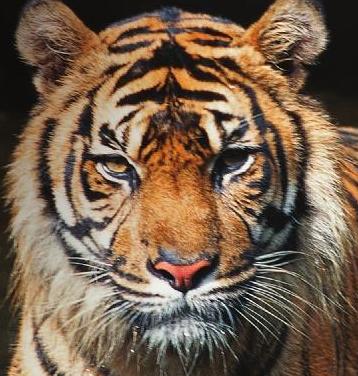
The white tiger is an elusive variant of the Bengal tiger (Panthera tigris tigris), recognized for its striking white fur with dark stripes. This rare coloration results from a genetic mutation that affects pigmentation, particularly a recessive allele that inhibits the production of the typical orange color by limiting the red and yellow pheomelanin pigments. Notably, this variant can also occur in the Siberian tiger (Panthera tigris altaica), though it is primarily associated with Bengal tigers found in the Indian subcontinent.
White tigers are not a separate subspecies but a pigmentation variation of the Bengal tiger. Their unique appearance has made them a symbol of fascination and a subject of conservation debates. Despite their beauty, white tigers face challenges in the wild due to their conspicuous coloration, which makes them less effective hunters and more vulnerable to poaching.
Interestingly, white tigers exhibit distinct physiological traits compared to their orange counterparts. From birth, they are typically larger and grow at a faster rate, reaching full maturity between 2 to 3 years of age. This rapid growth may offer some survival advantages, though it also raises questions about genetic health and viability, as many white tigers are the result of inbreeding in captivity to preserve their rare traits.
Conservation efforts for white tigers are complex, as their preservation often involves captive breeding programs. While these programs aim to maintain genetic diversity, they also face ethical scrutiny over potential inbreeding and the welfare of the animals. The existence of white tigers in the wild is exceedingly rare, with most living in zoos and wildlife parks where they continue to captivate public interest.
In conclusion, the white tiger remains an iconic and controversial figure in wildlife conservation. Its unique genetic makeup and striking appearance draw attention to the broader issues of tiger conservation and the need for sustainable practices that protect the genetic health and natural habitats of all tiger subspecies.
White Tiger Conservation
Showing posts with label tiger. Show all posts
Monday, May 13, 2024
Monday, July 3, 2023
Indochinese Tiger
The Indochinese tiger, also referred to as Corbett's tiger (Panthera tigris corbetti), is named in tribute to Jim Corbett, a renowned British hunter who was frequently sought after to track down man-eating tigers and leopards in the early 20th century.
Indochinese tigers play a vital role as the primary mammalian predators in the majority of Asian tropical rainforest ecosystems. Their native habitat spans Southeast Asia, including China, Thailand, Laos, Burma, and Vietnam. The illegal trade of highly sought-after tiger parts stands as the main factor driving the rapid decline of the Indochinese tiger population.
When it comes to size, coloring, and skull shape, Indochinese tigers exhibit distinct characteristics that set them apart from other subspecies. They are approximately 20 percent smaller than Bengal tigers, which happen to be one of the largest tiger subspecies. Male Indochinese tigers can grow up to around 3 meters in length and weigh about 180 kg, while females typically measure slightly over 2 meters in length and weigh approximately 115 kg.
Their fur is characterized by its shorter length, darker coloration, and narrower stripes, enabling them to better withstand the heat of the tropical forest and blend in with their surroundings for enhanced camouflage.
The population of Indochinese tigers is currently experiencing a decline throughout their range due to the loss of habitats, expanding human populations, and the increasing demand for traditional medicines and wild meat.
Indochinese Tiger
Indochinese tigers play a vital role as the primary mammalian predators in the majority of Asian tropical rainforest ecosystems. Their native habitat spans Southeast Asia, including China, Thailand, Laos, Burma, and Vietnam. The illegal trade of highly sought-after tiger parts stands as the main factor driving the rapid decline of the Indochinese tiger population.
When it comes to size, coloring, and skull shape, Indochinese tigers exhibit distinct characteristics that set them apart from other subspecies. They are approximately 20 percent smaller than Bengal tigers, which happen to be one of the largest tiger subspecies. Male Indochinese tigers can grow up to around 3 meters in length and weigh about 180 kg, while females typically measure slightly over 2 meters in length and weigh approximately 115 kg.
Their fur is characterized by its shorter length, darker coloration, and narrower stripes, enabling them to better withstand the heat of the tropical forest and blend in with their surroundings for enhanced camouflage.
The population of Indochinese tigers is currently experiencing a decline throughout their range due to the loss of habitats, expanding human populations, and the increasing demand for traditional medicines and wild meat.
Indochinese Tiger
Tuesday, October 30, 2012
Sumatran Tiger (Panthera tigris sumatrae)
Sumatran tiger is the last remaining tiger of Indonesia. Indonesia used to be home to three kinds of tigers: the Bali tiger, the Java tiger and the Sumatran tiger. Now both the Bali and the Java tigers have become extinct, and Sumatran tigers are critically endangered.
At about 250 pounds, the Sumatran tigers is the smallest of living tigers. The tiger lives in a forest habitat and also has the most stripes, which are very close together.
Sumatran tigers is light colored and it still can be found in the national parks and lowland forests of north Sumatra. It is the last stronghold of tigers in the Indonesian archipelago.
The Sumatran tiger is fast becoming an endangered species because the forests are being cut down to grow crops and build new towns.
It is estimated that about less than 500 of Sumatran tigers live in the wild, but about 100 of them living in five national parks in Indonesia.
Sumatran Tiger (Panthera tigris sumatrae)
At about 250 pounds, the Sumatran tigers is the smallest of living tigers. The tiger lives in a forest habitat and also has the most stripes, which are very close together.
Sumatran tigers is light colored and it still can be found in the national parks and lowland forests of north Sumatra. It is the last stronghold of tigers in the Indonesian archipelago.
The Sumatran tiger is fast becoming an endangered species because the forests are being cut down to grow crops and build new towns.
It is estimated that about less than 500 of Sumatran tigers live in the wild, but about 100 of them living in five national parks in Indonesia.
Sumatran Tiger (Panthera tigris sumatrae)
Saturday, October 8, 2011
Malayan tiger

The tiger is a member of the cat family that lives in the forest of Asia. It has eight own subspecies. Two of these became extinct in the last hundred years.
One of the six remaining subspecies is the Malayan tiger. The Malayan tiger subspecies is designated Panthera tigris jacksoni to honor the dedication and career of tiger conservationist Peter Jackson who former head of IUCN/SSC Cat specialist Group.
The Malayan tiger was classified as an Indochinese tiger until 2004, when scientist discovered differences between the tigers’ genes.
The male tiger is much larger than the female and has a wider home range. It is found only in the southern part of the Malay Peninsula.
The exact population is unknown but is considered by the WWF to be around 500, the vast majority of which are found in the states of Pahang, Perak, Terengganu and Kelantan.
The Malayan tigers body is similar to the Indochinese tiger’s and it is the approximated size of the Sumatran tiger.
Malayan tigers are sparely distributed. They can be found in isolated small forest, secondary vegetation and abandoned agriculture land or in areas low human density.
Malayan tiger
Subscribe to:
Posts (Atom)
Popular Posts
-
The Grey-cheeked Thrush ( Catharus minimus ), affectionately nicknamed the "Grey-cheese bird" due to a playful mispronunciation, i...
-
The red-headed woodpecker ( Melanerpes erythrocephalus) stands out among North American birds with its vivid crimson head, jet-black back, ...
-
Hedgehogs are small, spiny mammals belonging to the subfamily Erinaceinae within the family Erinaceidae. There are seventeen species of hedg...
-
The Psittrichas fulgidus , commonly known as the Dracula parrot, is a striking and unique bird native to the rainforests of New Guinea. This...
-
The American bison, often called the buffalo, stands as an iconic symbol of the Great Plains, embodying the resilience of North America'...